$442 billion
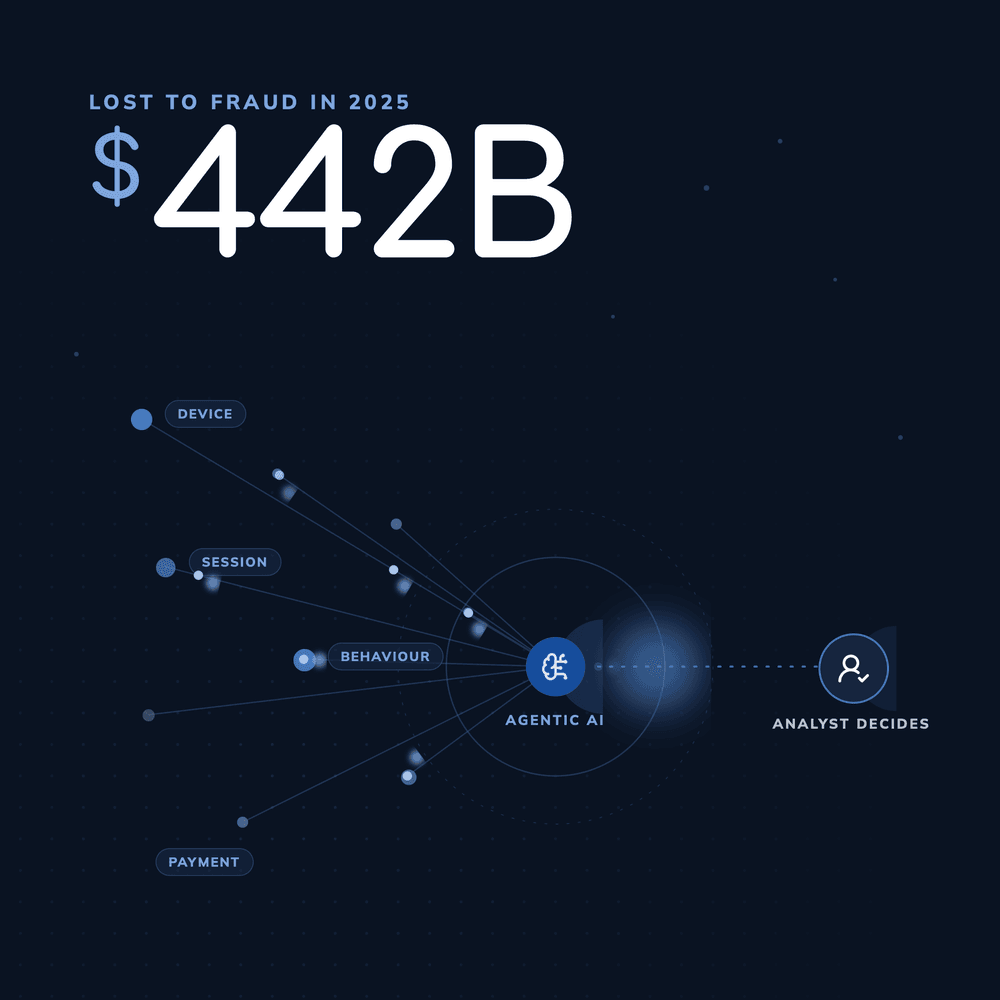
INTERPOL's March 2026 threat assessment puts financial fraud among the top five global crime threats, with fraud-related international police alerts up 54% year over year. Europe alone recorded a 69% increase, the sharpest of any region.
What's driving it isn't just more criminals. It's better tools in their hands. LLMs, synthetic identity kits, and Fraud-as-a-Service platforms have collapsed the barrier to entry, and investigators now estimate that AI-enabled schemes are roughly 4.5x more profitable than those without. Voice and video clones can be spun up from as little as 10 seconds of audio. The economics have shifted decisively in the attacker's favor.
Here's the uncomfortable part for defenders: rule-based systems and post-transaction review were built for a slower threat. A human analyst needs hours to spot a pattern, while an AI-driven attack executes in seconds. By the time a static threshold fires, the money has moved, often through a "trusted" channel that never triggered a check.
The answer isn't more rules, because the rules are exactly what these schemes are built to slip past. A predictive model scores one signal and waits. Static automation fires only on a fixed condition, like a card declined for an unusual purchase abroad. Fraud that stays under the threshold, or spreads its traces across the device, the session, the behavior and the payment, walks straight through. This is where agentic AI changes the game. Rather than following a fixed path, it reasons across those siloed signals, weighs them in context, and decides what to do next: is this anomalous for this customer, does it connect to a wider pattern, does it need to be held now or escalated to an analyst? It runs in real time, learns continuously from every confirmed fraud and every false alarm, and it acts within guardrails humans set, never as an unsupervised black box.
That last point matters. The goal was never to remove people. Agents absorb the volume by correlating signals, enriching the case, and triaging what's urgent, so an analyst's judgment lands where the cost of a wrong call is highest, and every human decision feeds back to make the next one sharper. Faster and more accurate at the same time.
At IT Natives we help banks put this into practice, designing and integrating agentic fraud workflows across the customer journey: real-time decisioning across siloed signals, explainable and audit-ready by design, with human-in-the-loop oversight from the start. The technology is only half the job. Getting it to fit your policies, data, and risk appetite is the other half. If agentic AI is on your roadmap, let's walk through what works and what doesn't.