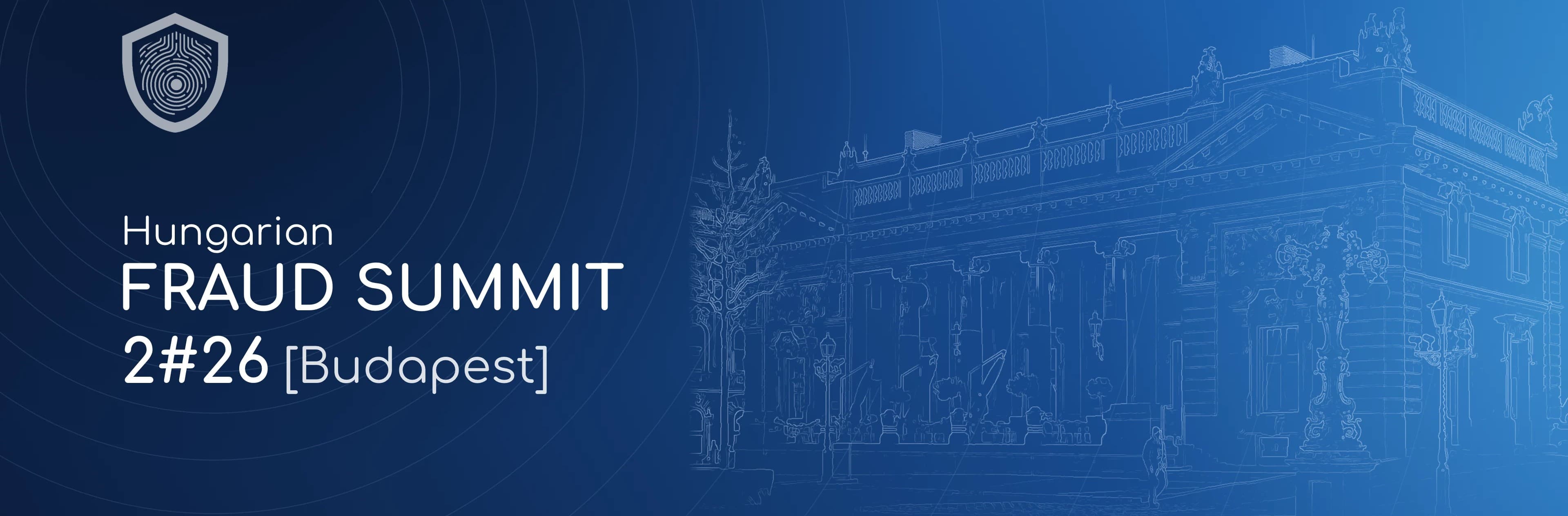
Hungarian Fraud Summit 2026
- Date19 November 2026
- VenueFőőrség Étterem és KávéházBuda Castle, Budapest
- AttendanceInvitation only
Where Hungary’s fraud fighters meet
The 2026 edition
This year’s Summit will focus not only on the current challenges in the fight against fraud, but also on related and emerging areas that are becoming increasingly significant. These include the fight against money laundering, the growing role of AI in the toolkit of both fraudsters and those fighting fraud, and, as a new topic, the challenges posed by quantum computing.
Financial fraud today
Scam patterns, mule networks and the decisioning practice that stops them before settlement.
Anti-money laundering
Where fraud and AML teams meet: shared signals, shared cases, one view of the customer.
AI on both sides
Generative attacks and deepfake-driven social engineering — against AI-assisted detection and triage.
Quantum computing
New this year: what post-quantum cryptography means for payment security timelines.
Programme
The fight against fraud today goes far beyond detecting suspicious transactions. Fraudsters are adapting faster, attacks are becoming increasingly organized, while financial services and customer journeys are being digitized at unprecedented speed.
- Where does the line between fraud and money laundering lie today?
- How is AI changing the toolkit of both fraudsters and those fighting them?
- How can we uncover a mule network when the threat is revealed not by a single transaction but by a whole web of connections?
- And while we are looking for answers to these questions, we also need to prepare for the next technological shift: how ready are we for the challenges posed by quantum computing?
At this year’s Hungarian Fraud Summit, we will explore these questions – from the current challenges of financial crime to the impact of AI and post-quantum technologies.
At the Hungarian Fraud Summit, we will look not only at how to respond to the threats we know today, but also at the challenges we need to start preparing for now.
Join us as we explore where financial crime is heading – and where fraud prevention needs to go next.
Agenda
09:00–09:15
Welcome Speech
Zoltán Pogátsa
Balázs Rakovszky
IT Natives
Gábor Füredi
IT Natives
09:15–09:40
Keynote – The Price of Trust: Why Has Fraud Prevention Become a Core Service of Modern Banking?
Abstract: Keynote – The Price of Trust: Why Has Fraud Prevention Become a Core Service of Modern Banking?
When a customer entrusts their money to a bank, they are entrusting more than money: they are entrusting their trust. But what does it take to keep that trust in a world where money moves in seconds, fraud grows ever more sophisticated, and it is increasingly not the bank but the customer who becomes the target of attacks?
Norbert Kováts
General Manager Daily Banking and Operations
K&H Bank
09:40–10:05
How AI Is Reshaping Digital Fraud Operations
Abstract: How AI Is Reshaping Digital Fraud Operations
Artificial intelligence is reshaping the way digital fraud campaigns are created and executed. Processes that once required specialized skills or significant time can now be completed faster, more efficiently, and at greater scale. In this talk, Lukáš Jakubíček will walk through concrete real-world examples showing how modern tools powered by AI can be misused to streamline the preparation and execution of fraudulent campaigns, helping defenders better understand the shifting threat landscape.
Lukáš Jakubíček
Lead Principal Solution Consultant
ThreatMark
10:05–10:30
The Hacked Human – The Other Side of AML: Mule Networks and Deceived Offenders
Abstract: The Hacked Human – The Other Side of AML: Mule Networks and Deceived Offenders
Financial institutions play a key role in the fight against money laundering, yet when crimes are committed, the human factor remains the weakest link. Just as social engineering targets victims, many on the perpetrators' side also become part of money laundering chains as victims of deception themselves.
This presentation explores how international networks built on the crime-as-a-service model are strengthening organised crime, and what motivates those who, often unknowingly, help launder criminal proceeds. Case studies presented through AI-generated videos highlight the responsibility of each actor involved, including the importance of bank employees' preparedness and good-faith conduct. Finally, the presentation offers recommendations for strengthening prevention and communication, reviewing the tools currently available and what is still needed – not only by law enforcement, but by all of us.
dr. Péter Farkas
Police Colonel, Head of the Economic Crime Department
BRFK
10:30–10:50
Coffee break
10:50–11:15
From Alerts to Networks: The Future of Mule Detection and Financial Crime Prevention
Muken Ladva
AML Strategy Lead
NICE Actimize
11:15–11:40
Digital Onboarding and Straw-Man Accounts: Pressure from Both Sides, One Dilemma (The Friction Paradox of Growth and Security)
Abstract: Digital Onboarding and Straw-Man Accounts: Pressure from Both Sides, One Dilemma (The Friction Paradox of Growth and Security)
When speed works for criminals too. Fast, frictionless account opening is now a baseline expectation in digital banking — but how can onboarding that takes a few minutes be reconciled with protection against organised crime? The talk shows how the classic straw-man model has grown into industrial-scale, technology-enabled “Mule-as-a-Service” networks, and why traditional, static KYC checks are no longer enough on their own. The focus is on dynamic, risk-based defence: how analysing telemetry, behaviour and network connections helps recognise suspicious patterns while onboarding stays fast for low-risk customers. The goal is not to stop digital onboarding, but to stop unchecked onboarding.
dr. Nóra Kéri
Financial Crime Compliance Manager
Revolut
11:40–12:05
Beyond the Silos: Why Fraud Prevention and AML Need a Unified Anti-Financial Crime Approach
Abstract: Beyond the Silos: Why Fraud Prevention and AML Need a Unified Anti-Financial Crime Approach
Are fraud and money laundering two separate problems, or two sides of the same criminal process? Banks have traditionally defended against them with separate organisations, systems and processes — but criminals do not recognise those boundaries. The talk shows how an Anti-Financial Crime approach can connect fraud and AML information, controls and expertise. Alongside Erste’s experience in Hungary, it covers the direction of travel in Western Europe and where the AMLA, AMLR and PSR/PSD3 regulatory environment may steer banks. The question is not fraud or AML. It is whether we can see the full picture of financial crime.
dr. Anna Kósa
Head of Compliance
Erste Bank Hungary
12:05–12:30
New Capabilities for Existing Monitoring: Data and AI in Fraud Defence
Gábor Füredi
IT Natives
12:30–14:00
Lunch
14:00–14:25
AML Challenges for the Insurance Sector
Abstract: AML Challenges for the Insurance Sector
New European regulation, data-driven operations and technological advancement are fundamentally reshaping money laundering and fraud risks in the insurance sector. This presentation examines these changes and the new questions they raise for designing effective and proportionate controls.
Dániel Bernáth
Manager – Forensics
EY
14:25–15:10
Round Table – Who Pays the Bill? The Impact of the New Curia Ruling on Reimbursement Practice
János Almádi
Economist, Cyber Security Expert, Managing Director
CyberShield Consulting Hungary
Dr. Tibor Kevés
Attorney at Law
Dr. Tibor Kevés Law Office
Norbert Kiss
Fraud Prevention Director
MBH Bank
Zénó Amtmann
Head of Security Governance Department
OTP Bank
Lukáš Jakubíček
Lead Principal Solution Consultant
ThreatMark
15:10–15:35
Already Here – or Not Yet? AI and the Post-Quantum Threat (in the Financial Sector)
Abstract: Already Here – or Not Yet? AI and the Post-Quantum Threat (in the Financial Sector)
Two technological shifts are shaping IT — and with it the cybersecurity of the financial sector — at the same time. Both may have a significant impact, but their timelines differ fundamentally. AI is no longer a future threat: attackers already use it for reconnaissance, social engineering, phishing, fraud, deepfakes and in part for malware development, while defenders use the same technology to speed up detection, analysis, incident response and the automation of security processes. The question for the financial sector is no longer whether AI will arrive, but who can use it, and how effectively. The cryptographic threat posed by quantum computers is far harder to pin down. No one knows exactly when a capability will exist that seriously endangers today’s widely used public-key cryptography, yet because of the “harvest now, decrypt later” attack model, data that must stay confidential for a long time is partly at risk already — and assessing and replacing the cryptographic infrastructure of a large financial institution can take years. The technical answer is taking shape: NIST’s first post-quantum standards are available, and the European Union has set out a concrete transition roadmap. The talk puts the two side by side: with AI, a technological arms race already under way; with post-quantum, a race we must prepare for although we may not yet have heard the starting pistol. For financial institutions both lead to the same question: how to prepare for the next technological leap while keeping defences working against today’s threats?
Tamás Marsi
Head of Department
Hungarian National Cyber Security Centre
15:35–16:00
The Quantum Shift: New Business Opportunities, Expiring Secrets?
Abstract: The Quantum Shift: New Business Opportunities, Expiring Secrets?
How long must our encrypted data stay secret: five, ten or thirty years? And will its protection hold out that long? A talk on the business promise of quantum computing, the future of digital trust, and the steps we can already take today.
Zoltán Peskó
IBM Quantum Ambassador
IBM
16:00–16:20
Coffee break
16:20–16:40
Future-Proofing Authentication: Security, Trust and Resilience
Abstract: Future-Proofing Authentication: Security, Trust and Resilience
Authentication is evolving in response to sophisticated fraud, new regulations, and emerging security threats. With PSD3/PSR, the European Digital Identity Wallet, and post-quantum authentication reshaping the landscape, financial institutions need a more connected and adaptable authentication strategy. We’ll explore how they can bring digital identity, risk-based authentication, and crypto-agility into their long-term strategy to strengthen security and resilience without compromising customer experience.
Ondřej Kupka
Regional Lead – Digital Identity
Wultra
16:40–17:00
The Role of Mobile Devices in Fraud Prevention: Through Apple’s Lens
Abstract: The Role of Mobile Devices in Fraud Prevention: Through Apple’s Lens
Mobile devices and the Apple ecosystem around them offer many features that together provide significant protection against fraud. Some protect us automatically; others need to be used deliberately — and knowing both is what moves users’ payment habits towards safer options. The post-quantum era and the malicious use of AI, meanwhile, challenge companies above all. What can we do to close the gap in the shield? The talk presents a selection of these features in an accessible way.
Tamás Mihály
Head of Apple Business, Apple and Microsoft Systems Engineer
IKON Informatika
17:00–17:20
Data Sharing – How Can FRIDA and the New Regulations Help Fraud Fighters
Abstract: Data Sharing – How Can FRIDA and the New Regulations Help Fraud Fighters
The steadily increasing losses caused by fraud and scams are making closer, faster cooperation between banks more important than ever. Banking AML and Fraud teams experience this every day: when they need to reach another bank about a specific case, they often still rely on phone calls, emails or other unstructured and slow communication channels to exchange information. But there is another way. In several countries, operational, case-level bank-to-bank data-sharing infrastructures have already been in place for years, enabling faster and more structured cooperation – and the European regulatory environment is increasingly supporting such approaches. This session will explore the practical experience with these infrastructures and examine the benefits they can offer to banks and regulators in strengthening the fight against fraud and scams.
Barnabás Ferenczi
Strategic Partner of IT Natives
IT Natives, Salv
17:20–17:40
Data Sharing in Practice: What Can We Learn from the Estonian Model?
Abstract: Data Sharing in Practice: What Can We Learn from the Estonian Model?
The presentation will share the best practices of sharing information between banks and other institutions in Estonian financial sector for tackling ML/TF and other financial crimes. The presentation will also cover the user perspective of AML Bridge tool used for exchanging information.
Madis Reimand
Head of Financial Crime Risk Reporting Unit
Luminor
17:40–18:30
“Hauszmann’s Horses” – Guided Tour at the Royal Riding Hall















We reserve the right to change the programme.
Venue
Főőrség Étterem és Kávéház
Szent György tér 4, Buda Castle1014 Budapest, HungaryBus 16 from Széll Kálmán tér or Deák Ferenc tér to Dísz tér, 3 minutes on foot.
Castle funicular from Clark Ádám tér, then 5 minutes through the castle courtyard.
By car paid parking is available in the Castle District; we recommend arriving by public transport.

Partners
The Summit is made possible by the technology partners who work with Hungarian institutions every day.